Web Development
Why “Just One More Feature” Can Ruin a Web Project
Small feature requests can quietly turn a simple website into a complex project. Here’s how better planning, clear scope, and smart priorities help build better products faster.

· 7 min read
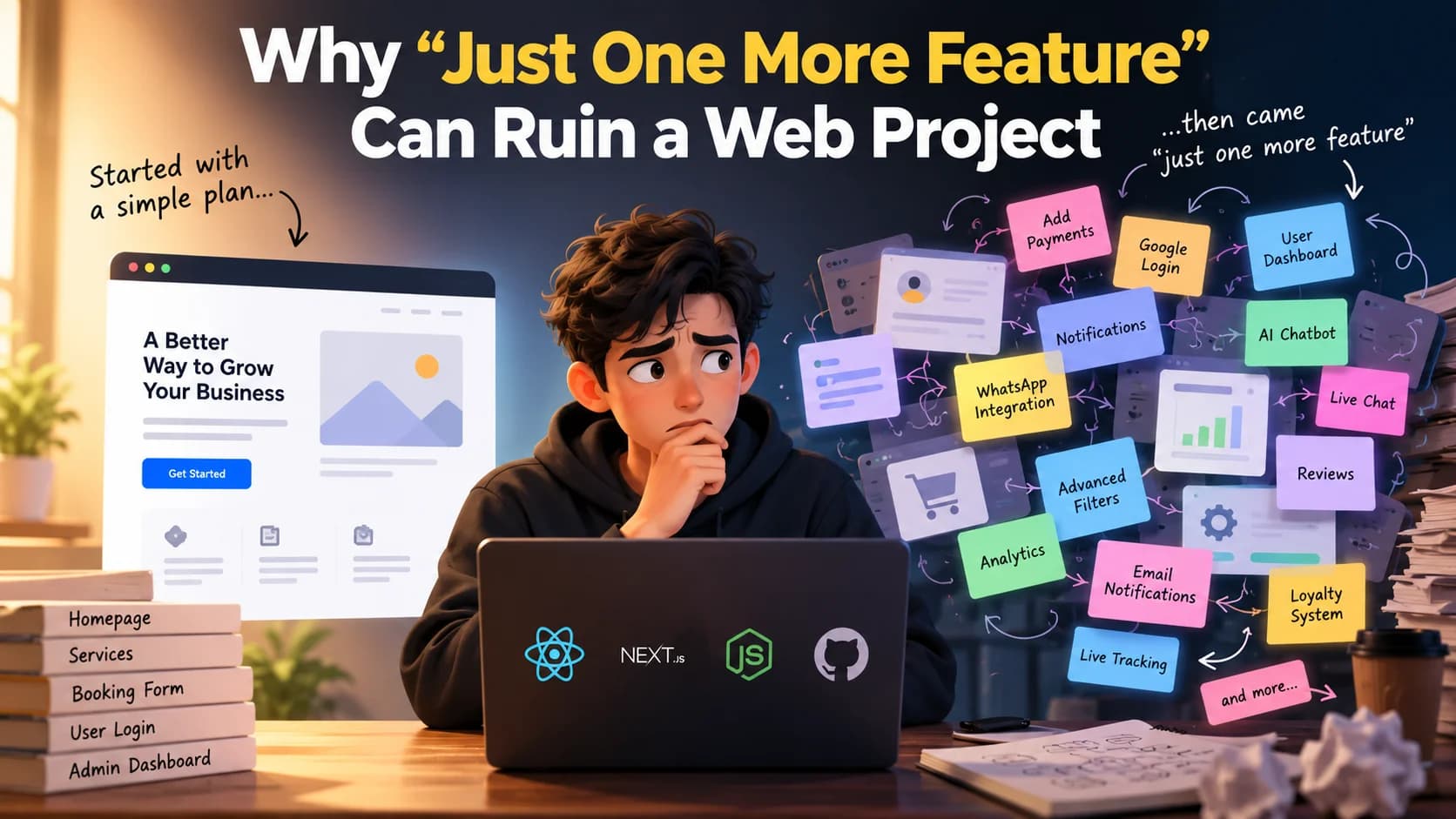
Almost every web project starts with a simple idea.
“We just need a website.”
Then development begins.
A few days later:
“Can we also add Google login?”
“Maybe users should have a dashboard.”
“Can we add notifications too?”
“What about an AI chatbot?”
“And it would be nice if users could message each other.”
None of these ideas are necessarily bad.
Actually, some of them might make the product much better.
The problem starts when “just one more feature” keeps happening without changing the original timeline, budget, or plan.
This is something developers usually call scope creep.
And it can quietly destroy an otherwise good project.
What Is Scope Creep?
Imagine a client asks me to build a simple booking website.
The original requirements are:
- Homepage
- Services page
- Booking form
- Customer login
- Admin dashboard
We agree on the design, features, timeline, and price.
Development starts.
Then new requests appear.
The client wants online payments.
Then email notifications.
Then WhatsApp integration.
Then appointment reminders.
Then customer reviews.
Eventually, the project that started as a simple booking website has turned into an entire booking platform.
The problem isn't adding features.
The problem is adding them without adjusting the project plan.
Every feature creates more work than what users normally see.
A Button Is Rarely “Just a Button”
This is something I think many non-developers don't realize.
A client might say:
“Can you just add a button where users can cancel their booking?”
From the outside, it sounds simple.
But as a developer, I need to think about what happens behind that button.
Can anyone cancel?
Can users cancel five minutes before the appointment?
Should the business receive a notification?
Should the available time slot become bookable again?
What happens if the customer already paid?
Should the payment automatically be refunded?
Should the cancellation appear inside the admin dashboard?
Should the user receive an email?
Suddenly, one small button affects:
- frontend UI
- backend logic
- database
- authentication
- payments
- notifications
- admin functionality
This is why understanding the business logic behind a feature is often more important than writing the code itself.
Features Have a Hidden Cost
When people think about adding a feature, they usually think about development time.
But there are other costs too.
Every new feature increases the number of things that can break.
It needs testing.
It may require database changes.
It might introduce security concerns.
It may affect performance.
The UI may need to change.
Existing features may need to interact with it.
And after the website launches, somebody still needs to maintain it.
This is why I don't think the goal of a web project should be:
“How many features can we add?”
The better question is:
“Which features actually help the user or the business?”
That single question can save a huge amount of development time.
Start With the Core Problem
When I plan a project, I try to identify the main problem first.
For example, imagine we're building a platform for a restaurant.
The main goal might be:
Allow customers to easily order food online.
Then the first version doesn't necessarily need 30 features.
It might only need:
- Menu
- Product details
- Cart
- Checkout
- Order management
- Basic admin dashboard
That is already enough to solve the main problem.
Later, based on actual users, we could introduce:
- loyalty points
- recommendations
- live order tracking
- coupons
- reviews
- AI support
- advanced analytics
This approach gives the business something usable much faster.
MVP Doesn't Mean Bad Product
I sometimes see people misunderstand the term MVP — Minimum Viable Product.
They think it means building something cheap or incomplete.
That's not really the idea.
A good MVP should still be:
- usable
- secure
- responsive
- properly designed
- fast
- reliable
It simply focuses on the most important functionality first.
Think about it like opening a restaurant.
You don't need 200 dishes on opening day.
You need a smaller menu that you can execute really well.
Then you learn what customers actually want.
Software works in a very similar way.
Build Based on Users, Not Assumptions
This is probably one of the most important lessons I've learned while building projects.
Before real users arrive, we make assumptions.
We think:
“Users will love this feature.”
“This dashboard needs ten different charts.”
“Everyone will use the AI assistant.”
Maybe they will.
Maybe they won't.
The only way to know is to put the product in front of real people.
Imagine spending three weeks developing a complicated feature and later discovering that almost nobody uses it.
That time could have gone into improving something users actually care about.
That's why I like the idea of:
Build → Launch → Learn → Improve
instead of:
Build forever → Try to make everything perfect → Eventually launch
How I Handle New Feature Requests
When a new idea comes during a project, I don't automatically think:
“No, that's outside the scope.”
First, I try to understand why the feature is needed.
Sometimes the requested feature isn't actually the best solution.
For example, someone might say:
“I need a live chat system.”
But after understanding their business, maybe what they really need is simply a WhatsApp contact button.
Building a complete real-time messaging system could require authentication, databases, notifications, conversations, online status, message storage and much more.
A WhatsApp integration might solve their actual problem in a fraction of the time.
Good development isn't always about writing more code.
Sometimes it's about knowing which code doesn't need to be written.
I Like Separating Features Into Three Groups
When planning projects, I find it useful to think about features like this.
Must Have
The product cannot properly work without these.
For an e-commerce store:
- products
- cart
- checkout
- payment
- order management
Should Have
These improve the experience but aren't necessary for the first launch.
For example:
- favorites
- reviews
- advanced filters
- discount codes
Could Have
These are good ideas for later.
Maybe:
- AI recommendations
- loyalty system
- advanced analytics
- referral program
This makes development priorities much clearer.
Instead of treating every idea as urgent, we build what matters first.
Scope Should Be Flexible — But Controlled
I don't believe projects need to follow the original specification blindly.
Good products evolve.
Sometimes an idea appears during development that genuinely improves the entire product.
It should be considered.
But there should be a clear conversation around it.
If a feature adds three more days of development, then the timeline needs to reflect that.
If it requires an external service with monthly fees, the client should know.
If it changes the database structure, we should think about the consequences.
Good client-developer communication prevents most problems here.
What I Want Clients to Understand
When you hire a developer, you're not only paying someone to write JavaScript, React components, or API routes.
You're also paying them to think about questions like:
- What happens when something fails?
- How will this work on mobile?
- What if thousands of records exist later?
- Who is allowed to access this?
- What happens if a user refreshes the page?
- How should errors be handled?
- How will the business manage this information?
- Can this feature grow later?
A website can look very simple from the outside while having a lot happening behind the scenes.
That is why proper planning matters.
My Approach to Building Web Projects
When I build a project, I prefer this process:
Understand the problem → Define the core features → Design the user flow → Build → Test → Launch → Improve
Not:
Add every possible feature before anyone uses the product.
I enjoy building modern applications with technologies like React, Next.js, Node.js and modern databases.
But technology is only part of development.
The bigger challenge is figuring out what should actually be built.
And sometimes the best thing a developer can say isn't:
“Yes, I can build that.”
It's:
“Yes, we can build that — but let's first check whether your users actually need it.”
That's the difference between simply writing code and building a product.
Final Thoughts
Ideas are easy to add.
Every new feature can sound exciting during a meeting.
But successful web products aren't necessarily the products with the most features.
They're the products that solve their users' problems clearly and reliably.
Start with the important things.
Launch.
Watch how people use it.
Then improve it.
Because in software development, sometimes less code creates a better product.
If you're building a website, SaaS product, dashboard, marketplace or another web application and want someone who thinks beyond just the code, feel free to connect with me.
I'm Ehan Siddique, a web developer focused on building modern, practical web experiences using technologies like React, Next.js and Node.js.
I regularly share what I learn from building real projects, solving development problems, and experimenting with modern web technologies.
- #Web Development
- #React
- #Next.js
- #Software Development
- #MVP
- #Startups
- #Freelancing
- #Client Work
- #Scope Creep
- #Product Development

Written by
Ehan Siddique
MERN Stack Developer & Digital Marketer from Tangail, Bangladesh, with 7+ years of experience building fast, SEO-optimized websites for 300+ clients worldwide.
Keep reading

· 8 min read · Business Websites
Your Website Looks Good, But Is It Actually Bringing You Customers?
Your website can look great and still lose customers. Here are the common problems I look for as a developer and what businesses can do to fix them.
Read article: Your Website Looks Good, But Is It Actually Bringing You Customers? →